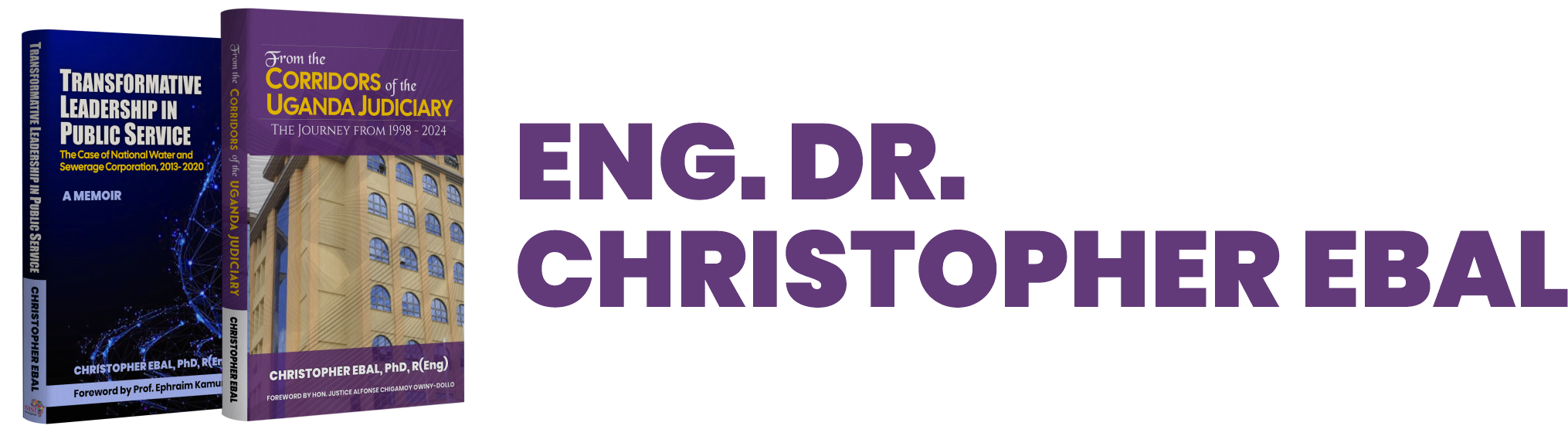

By Eng. Dr. Christopher Ebal
Public service is one of those professions where you can work very hard every day and still discover that the problem you were trying to solve has grown two new heads overnight. A leaking pipe becomes a water shortage; a delayed file becomes a frustrated citizen; a small administrative weakness becomes an institutional crisis. This is why public service requires more than management. It requires transformative leadership.
I have learned that the difference between management and transformative leadership is often found in one simple question: Are we merely keeping the institution running, or are we making it better?
A manager may ask, “How do we deal with today’s problem?” A transformative leader asks, “Why does this problem keep occurring, and what must we change so that tomorrow’s problem is different?”
My experience at the National Water and Sewerage Corporation (NWSC) gave me a practical demonstration of this principle. When I became Board Chair, one of my first priorities was to understand the institution before attempting to change it. I listened, observed, asked questions and tried to understand the culture. I have always believed that leadership begins with listening. As I once put it, “Fish starts rotting from the head.” If the leadership is confused, the confusion eventually travels down the organisation.
Transformation therefore begins at the top—but it cannot remain at the top. People must understand the purpose of the institution and see how their individual work contributes to it.
During the period of NWSC’s geographical expansion, the Corporation moved from serving roughly 23 towns in 2013 to 258 by 2020. That was not simply a matter of drawing more towns on a map. It required changes in strategy, systems, infrastructure, organisational capacity and the way services were delivered. NWSC’s own strategic documents described the expansion from 24 towns to 162 between 2013 and 2016 as a significant transformation of its business and service model.
But numbers alone do not constitute transformation. A public institution exists ultimately for people. The real test is whether citizens experience a difference.
This is why I have always believed that the customer must be treated as king. The question is not merely whether an institution has followed its procedures. The question is whether those procedures are helping it fulfil its mandate.
Transformative leadership also requires courage. Sometimes the easiest thing is to preserve an old system because “that is how we have always done it.” But institutions do not grow by worshipping yesterday. Leaders must be willing to challenge entrenched practices, embrace innovation and speak truth to power—while remaining accountable, respectful and grounded in values.
Most importantly, leadership is not the exercise of authority. It is the stewardship of trust. People may obey your position because you are their boss, but they will give their best when they trust your integrity, competence and intentions.
Public service therefore demands leaders who can see beyond the next meeting, the next budget or the next quarterly report. They must ask what institution they are building and what kind of society that institution will help create.
My greatest lesson is simple: transformative leadership is not about leaving an impressive footprint on an institution; it is about leaving the institution stronger, more responsive and more capable of serving people after you have gone.
That, to me, is the real measure of public service.
And perhaps the most important question every public servant should ask before leaving office is not, “What did I gain?” but:
“What did I leave better than I found it?”
Leave a Reply