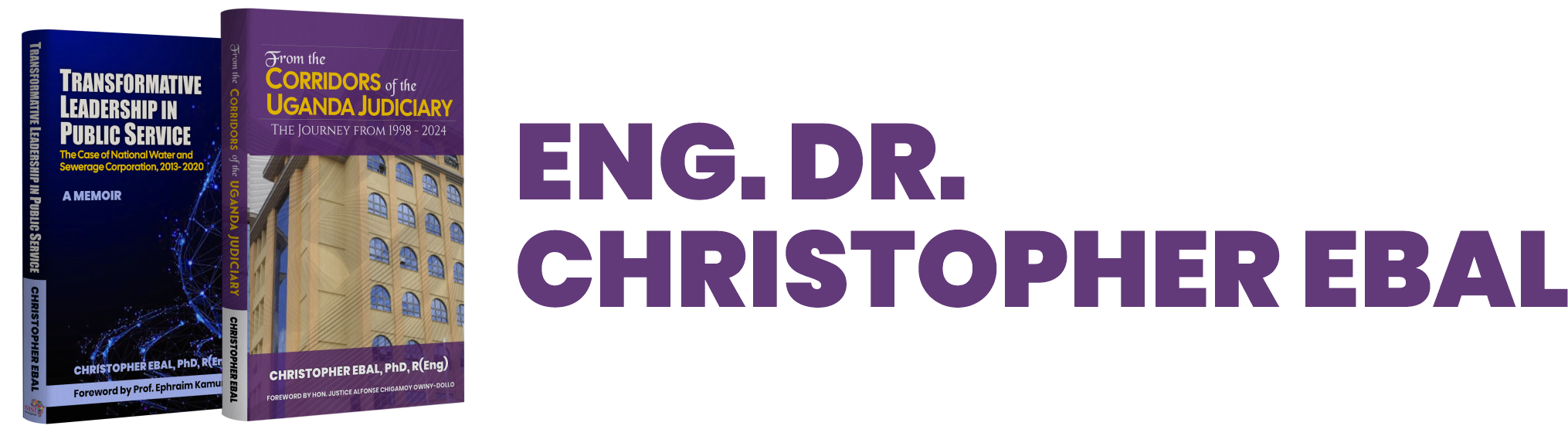

By Christopher Ebal
One lesson I learned during my years of service in the Judiciary is that you cannot build the future using yesterday’s tools. Infrastructure, like justice itself, must respond to the changing needs of society. As the demands on the Judiciary evolved, I realised that my responsibility was not simply to maintain buildings and facilities, but to help create an environment in which justice could be delivered efficiently, reliably and with dignity.
This required me to remain a student even when I was already expected to be a leader. I deliberately embraced continuous learning, new technologies and emerging management approaches. I learned from colleagues, consultants, contractors, professional literature and, sometimes, from mistakes. I discovered that experience is valuable, but experience without learning can easily become a comfortable way of repeating yesterday’s solutions.
I remember working on major Judiciary infrastructure projects where the old ways of doing things were no longer sufficient. A project could no longer be managed simply by knowing how to construct a building. We had to think about functionality, sustainability, technology, security, user experience, cost, timelines and the future demands that the building would have to accommodate. A courthouse is not just concrete, steel and glass. It is a place where people’s lives, rights and disputes converge. Every design decision therefore has consequences beyond engineering.
I also learned that no leader can know everything. For this reason, I encouraged teamwork and professional independence among the officers and consultants under my supervision. I wanted people to feel that they were not merely waiting for instructions from the Commissioner. If an engineer, architect, quantity surveyor or project officer saw a better way of doing something, I wanted that person to have the confidence to say so.
There is an interesting thing about leadership: sometimes the best idea in the room comes from the person with the least authority.
I therefore tried to create an environment where expertise could speak. I expected people to be accountable for their professional responsibilities, but I also gave them room to exercise their judgement. In my view, professional independence is not the absence of supervision; it is the confidence to do the right thing within one’s professional mandate.
Of course, public-sector projects rarely proceed without pressure. There were moments of uncertainty, competing priorities, resource constraints and difficult decisions. At such moments, it was tempting to become absorbed in the immediate problem—the delayed procurement, the contractor’s complaint, the budget constraint or the deadline that seemed to be moving faster than the project.
I learned to step back and ask a larger question: What are we ultimately trying to achieve?
That question helped me remain focused on the broader vision of transforming Judiciary infrastructure into modern, reliable and sustainable facilities capable of supporting effective justice delivery.
Looking back, I believe innovation and resilience are inseparable. Innovation helps us find better ways of doing things; resilience gives us the strength to keep pursuing those better ways when circumstances become difficult.
My experience taught me that staying relevant is not about knowing everything. It is about remaining curious enough to learn, humble enough to listen, courageous enough to adapt and resilient enough to keep going.
In public service, that combination can make the difference between simply occupying an office and actually fulfilling its mandate.
Leave a Reply